
How Kerala Businesses Can Sell Their Products Online Across India
In this article
Introduction
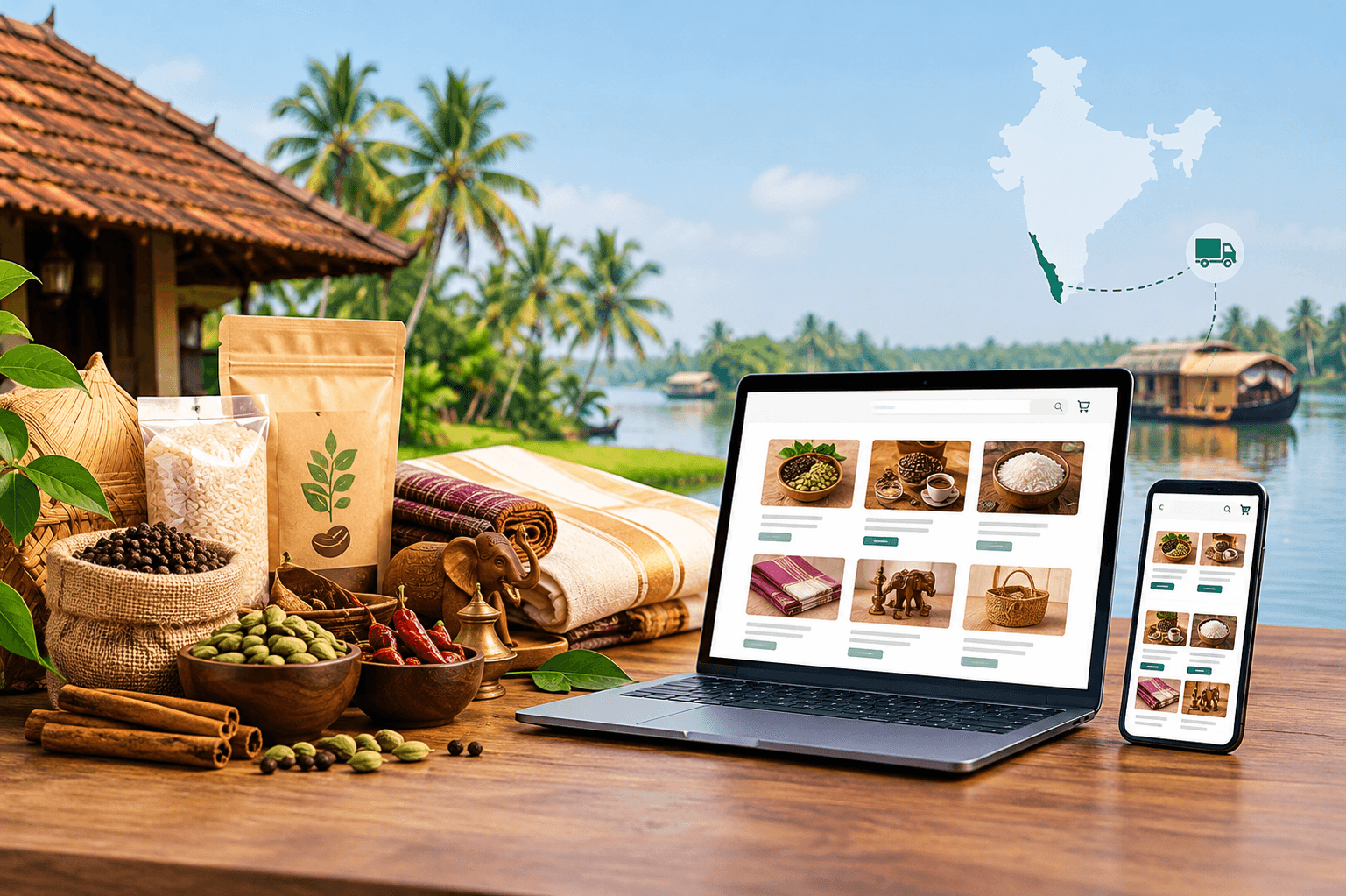
Kerala is known for products such as spices, coffee, traditional rice varieties, food products, handloom textiles, and handicrafts. Selling these products online can help businesses reach customers beyond their local markets.
However, launching an online store involves more than adding products to a website. Businesses need to consider GST requirements, food safety regulations where applicable, customer protection, secure payment processing, and reliable shipping.
This guide explains the essential steps for setting up an e-commerce website for Kerala products, with links to relevant official resources and service providers.
Step 1: Choose Between Your Own Website and a Marketplace
You can sell Kerala products through your own e-commerce website, an online marketplace, or both.
Your own website gives you greater control over your branding, product presentation, website experience, and customer communication. You are also responsible for managing the website, payment integration, order processing, customer support, and applicable legal requirements.
A marketplace provides an existing platform where customers can discover and purchase products. However, sellers must review the platform's fees, seller policies, payment terms, and applicable tax requirements.
Before choosing your sales channel, consider your product range, target customers, budget, delivery requirements, and plans for expanding into other states.
GST obligations can differ depending on what you sell, where your customers are located, your turnover, and whether you sell through an e-commerce operator. Review the latest information on the official GST Portal before deciding how to structure your online sales.
Step 2: Understand GST Requirements
GST registration and compliance are important considerations when selling products online in India.
Your registration requirements depend on your business circumstances and the applicable GST provisions. Selling through your own website and selling through an e-commerce operator can involve different rules.
Before launching your store:
- Confirm whether your business must register for GST.
- Check the requirements applicable to interstate sales.
- Review the rules for selling through e-commerce operators.
- Confirm the correct HSN classification and GST rate for each product.
- Configure invoices and tax calculations according to the applicable requirements.
- Display business and tax information wherever legally required.
Do not assume that every online seller has the same registration obligations. Certain exceptions and special conditions may apply, so confirm your position before accepting orders.
GST rates can vary by product classification. For current information, refer to the Central Board of Indirect Taxes and Customs (CBIC) and the GST Council. Check the relevant classification and applicable rate for each product rather than applying one rate to all spices, packaged foods, clothing, handicrafts, or other Kerala products.
For business-specific decisions, consult a qualified tax professional.
Step 3: Check Food Safety and Product Labelling Requirements
If you sell food products, such as spices, packaged snacks, coffee, rice, pickles, or other edible goods, check the applicable Food Safety and Standards Authority of India (FSSAI) requirements.
Depending on the nature and scale of the business, food businesses may need an FSSAI registration or licence. The appropriate category should be determined using the current rules and the official application system.
Before selling food online:
- Check the registration or licence applicable to your business.
- Follow the relevant food packaging and labelling requirements.
- Provide accurate product descriptions and ingredient information where required.
- Display applicable licence details and other mandatory declarations.
- Check shelf-life, storage, and expiry information where relevant.
- Ensure that product claims are accurate and supported.
You can review the latest requirements on the FSSAI official website and use FoSCoS, FSSAI's licensing and registration system, to check the relevant process for your business. For specific regulatory details, refer to the Food Safety and Standards Regulations.
Avoid relying on outdated turnover limits or unverified summaries of regulatory changes. Check the latest requirements directly with FSSAI before applying.
Step 4: Follow E-Commerce Consumer Protection Requirements
An online store should give customers clear information about the business, products, prices, delivery, and customer support.
The Consumer Protection (E-Commerce) Rules, 2020, and other applicable laws set out requirements for e-commerce businesses. The precise obligations depend on the business and how it operates.
Review your website to ensure that it provides the information and policies required for your business, which may include:
- The business's legal name and contact details.
- Customer-care information and a grievance-redressal process.
- Clear product descriptions and applicable product disclosures.
- Transparent pricing and a breakdown of applicable charges.
- Shipping, delivery, cancellation, return, and refund information.
- Privacy information explaining how customer data is handled.
Applicable grievance-handling timelines and disclosure requirements should be checked against the relevant legislation and rules. You can consult the Department of Consumer Affairs and India Code, the official repository of central legislation, for the relevant legal information.
Ensure your website policies accurately reflect how your business operates and meet the requirements applicable to your store.
Step 5: Highlight Kerala's Regional Products
Kerala has a wide range of regional products, including spices, coffee, traditional rice varieties, handloom textiles, and handicrafts.
Where relevant, product pages can explain the product's origin, production method, ingredients, packaging, and distinctive characteristics. Accurate information helps customers understand what they are buying and can make your store more useful.
Some products may qualify for protection under India's Geographical Indications (GI) system. However, a business should not use a GI name or claim GI status simply because its product comes from the same region.
Before making a GI claim:
- Check the official GI Registry.
- Confirm that the product and its geographical origin meet the applicable specifications.
- Verify whether the business is entitled to use the relevant GI name or authorised label.
- Avoid suggesting certification or authorisation that the business does not have.
The Geographical Indications Registry on the Intellectual Property India website provides information about registered geographical indications and the applicable system. Verify the product's status and your eligibility before making GI-related claims.
Step 6: Build an E-Commerce Website That Is Easy to Use
Your website should make it straightforward for customers to discover products, understand their features, complete purchases, and track orders.
Consider the following features when planning your online store.
Mobile-friendly design
Make sure the website works well on smartphones, tablets, and desktop computers. Product images, navigation, forms, and checkout should be easy to use on smaller screens.
Detailed product pages
Include clear product names, descriptions, photographs, available sizes or pack quantities, prices, and relevant product information.
For food products, include the applicable ingredient, labelling, food safety, and shelf-life information. For regional products, describe their origin accurately.
Secure checkout
Choose a payment provider that supports the payment methods your customers need. Ensure that payment processing, order confirmation, and failed-payment handling work correctly.
Order management
Connect the store to a suitable system for managing orders, stock, invoices, dispatch, and tracking. The exact integrations will depend on your e-commerce platform and business requirements.
Clear policies and customer support
Make relevant business contact details, shipping information, return and refund terms, and privacy information easy to find.
Search engine optimisation
Use descriptive page titles, helpful product descriptions, clear URLs, descriptive image text, and a logical website structure.
Good SEO helps search engines understand your pages and can make your products easier to discover. Refer to Google Search Central's SEO documentation for guidance on search-friendly websites and structured data.
Website performance also matters to the shopping experience. You can assess page performance using Google PageSpeed Insights and learn more about user-experience performance metrics through Web Vitals.
If you need professional help planning or building your online store, explore Thynck's web development services.
Step 7: Set Up Online Payments
An online payment gateway allows customers to pay through the payment methods supported by your provider and account.
Razorpay is one option businesses can evaluate for online payment processing. Before choosing a provider, review its current pricing, supported integrations, onboarding requirements, settlement terms, supported payment methods, and applicable service conditions.
A typical setup process involves:
- Creating an account with the provider.
- Submitting the business and identity information requested during onboarding.
- Completing the provider's verification process.
- Connecting the gateway to your website.
- Testing successful payments, failed transactions, refunds, and order confirmations before launch.
The documents required and the time needed for account activation can vary by business type and the provider's current policies.
Before making a decision, review Razorpay's current pricing, consult its payment integration documentation, and follow its official account creation process.
Do not assume that a particular transaction fee, promotional offer, settlement period, or document requirement applies to every account. Confirm the latest details directly with the provider.
Step 8: Arrange Shipping and Order Delivery
Reliable delivery is an important part of selling Kerala products to customers in other locations.
You can work directly with courier companies or evaluate a shipping aggregator that helps manage courier selection, shipment creation, tracking, and other delivery workflows.
Shiprocket is one service businesses can consider. Its suitability depends on your shipment volume, delivery destinations, package dimensions, product type, service requirements, and budget. Review the provider's current services and terms before choosing a shipping solution.
Before selecting a shipping provider, compare:
- Available delivery destinations and service coverage.
- Shipping charges based on actual and volumetric weight.
- Pickup arrangements and expected delivery timelines.
- Tracking and customer notification features.
- Cash-on-delivery availability and associated terms.
- Return-to-origin charges and handling.
- Claims, lost shipments, and damage policies.
- Integrations with your e-commerce platform.
For food and other sensitive products, use suitable packaging and follow the applicable storage, labelling, and transport requirements.
Test the complete shipping process before launch. Check how orders are collected, packed, dispatched, tracked, delivered, and handled when a customer is unavailable.
Shipping prices and service coverage can change. Obtain a current quote for your actual package and delivery route rather than relying on a general average.
Step 9: Calculate Your Costs Before Setting Product Prices
Your selling price should account for more than the product's purchase or production cost.
Depending on your business, additional costs may include:
- Product packaging and labelling.
- Website hosting and maintenance.
- Payment gateway charges and applicable taxes.
- Courier and packaging expenses.
- Marketplace commissions, where applicable.
- Marketing and customer acquisition.
- Returns, damaged shipments, and failed deliveries.
- Applicable business taxes and compliance expenses.
For example, if a product sells for ₹1,000, the amount remaining after payment and delivery expenses will depend on the actual gateway fee, shipping quote, packaging cost, and other applicable charges.
Use your provider's current rates and your own order data to calculate the real cost per order. Do not treat a sample calculation as a guaranteed cost or profit margin.
Step 10: Launch Checklist
Before launching your Kerala products online, use this checklist:
- Choose whether to sell through your own website, a marketplace, or both.
- Confirm applicable GST registration and compliance requirements.
- Verify product classifications and GST rates where relevant.
- Complete the required FSSAI registration or licensing process for food products.
- Check product labelling and other applicable legal requirements.
- Prepare accurate product pages, photographs, prices, and descriptions.
- Publish the business information and policies required for your store.
- Complete payment provider onboarding and verification.
- Connect and test your shipping or courier service.
- Test the website on mobile devices and desktop computers.
- Test orders, payments, cancellations, refunds, notifications, and tracking.
- Review the customer journey before promoting the store.
Build Your E-Commerce Website with Thynck
A successful online store combines a useful shopping experience with reliable payment processing, order management, shipping, and a clear website structure.
Thynck provides web development services for businesses looking to establish or improve their online presence. If you are planning to sell Kerala products online, the right website approach will depend on your products, business requirements, budget, and growth plans.
Explore our web development services or contact info@thynck.in to discuss your project.
Frequently Asked Questions
Need Expert Help?
Talk to our strategy team for a free digital audit & roadmap.